
Garda Park Smart Appeal - Theft from unlocked Vehicles
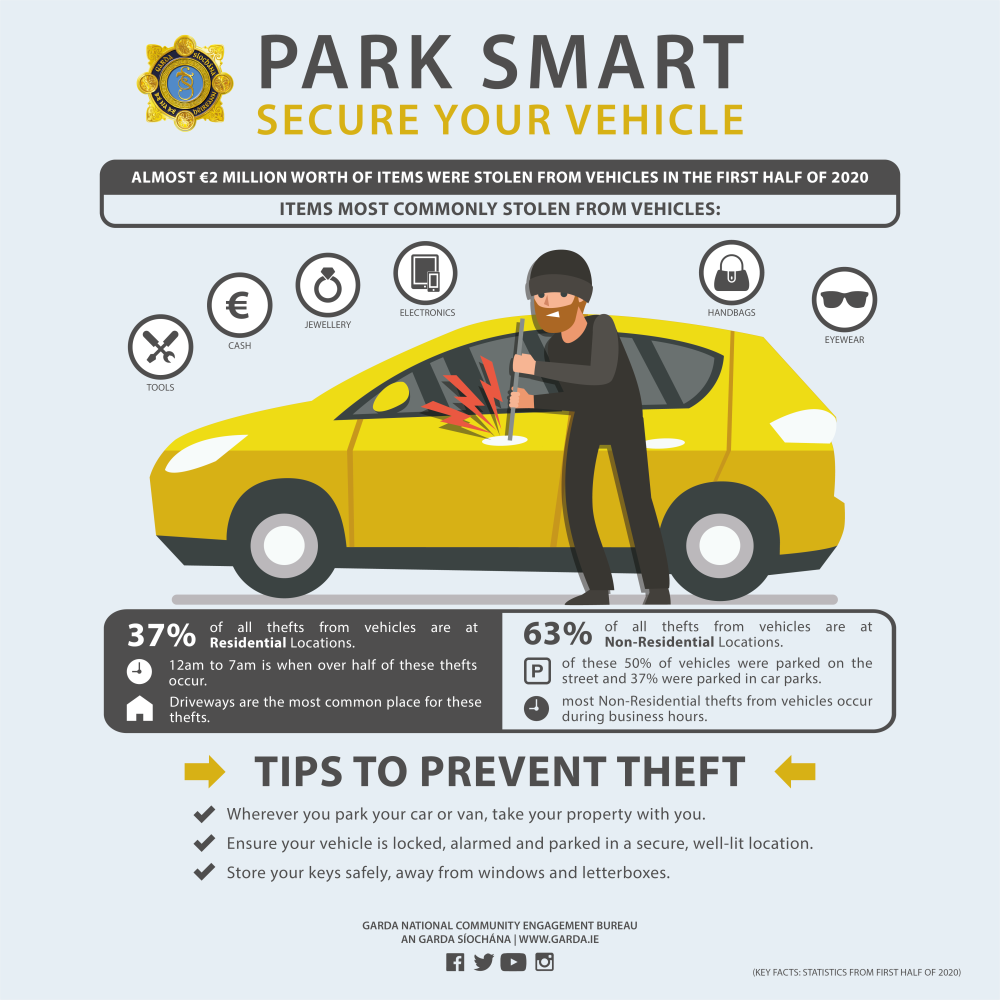
- 38% of all vehicles broken into were left unlocked
- Driveway is a common location for these thefts
- Over 50% of these thefts occur overnight (midnight to 7am)
Tips to Prevent Theft
- Whether you park your car or van, take your property with you
- Ensure your car is locked, alarmed and parked in a safe location
- Store your keys safely, away from windows and letterboxes
An Garda Síochána is appealing to motorists to park smart as new figures show that one-third of all vehicles broken into in residential areas had been left unlocked by the owner.
Figures from the Garda Analysis Service released today show that 8,571 vehicles parked at residential locations were broken into between 2015 and 2017. Of those, 2,824 were reported to be unlocked.
The analysis also shows that the most common location for these thefts was in driveways, and that half of the thefts occurred between 12midnight and 7am. Such thefts are happening throughout the country.
On average, over €340,000 worth of property was stolen from vehicles each year. Property stolen included cash, laptops, tools, sunglasses, jewellery and sports equipment.
Gardaí are appealing for all vehicle owners to ensure they lock their vehicle no matter where it is parked. Do not store valuables in the car, but if you do have to, keep them out of sight.
Sgt Kelvin Courtney from the Garda Crime Prevention National Centre of Excellence said, "Wherever you park your car or van, we would always advise you to take your property with you and ensure the vehicle is locked, alarmed and parked in a secure, well-lit location.
"Many of these thefts, particularly at residential locations, are avoidable with an average of 33% of vehicles being left unlocked in the last three years. Unfortunately, this poor practice has risen as 38% of vehicles were unlocked when they had property stolen from them in January 2018. We’ve even seen cases where two vehicles from the same household were unlocked and broken into.
"Sometimes it is impractical to remove tools and equipment from vehicles. In these cases, owners should take extra steps to ensure the safety of their property. Additional locking mechanisms to vehicles should be fitted. Consider a monitored vehicle alarm and tracking devices for valuable property. Reduce the payoff to the thief by marking and photographing the property and take a record of serial numbers, makes and models. Download the household property register for free from the Garda Website for your records.”
According to the Garda Stolen Motor Vehicle Investigation Unit, the vast majority of cars illegally entered or stolen from are done so using the vehicle’s key. The vast majority of vehicles stolen continue to be taken with keys obtained in burglaries.
An Garda Síochána’s advice surrounding any vehicle keys would always be to avoid leaving them on the hall table or near a door/window where they could be easily taken.
The regional breakdown of thefts from unlocked vehicles between 2015 and 2017 is:
Dublin: 1245
Eastern: 532
Southern: 411
Western: 261
Northern: 234
South Eastern: 141
We also wish to make the public aware of the fact that persons who collect cash from financial institutions/banks/ credit unions/ post offices leave the cash in their vehicles and leave the vehicle unattended as they deal with other business.
Below are some examples of cash stolen from vehicles in recent times:
January 2018- Clondalkin Area- €1000 taken from unattended car
February 2018-Galway area-€5000 taken from unattended car
March 2018 – Limerick area-€300 taken from unattended car
• Avoid using cash if possible
• Conceal all cash when entering and exiting the bank/post offices/credit unions
• Do not leave cash in unattended vehicles
• Be aware of your own personal security, and report anything suspicious to the Gardaí as soon as possible
The aims of community policing
- To provide the people in an area with their own dedicated Garda, someone with whom they can discuss everyday occurrences and build up a strong and supportive personal relationship.
- To help the residents of the area to prevent crime by supporting crime prevention initiatives such as Neighbourhood Watch and Community Alert.
- To work with other social agencies in the area to help curb crime and vandalism. (Guidelines for Making a Victim Impact Statement are available on the Garda Victim Liaison Office Tab)
** Kindly note that all enquiries in relation to local policing issues should be referred to your local Garda Station.
If you have any specific queries in relation to the National Model of Community Policing, the Garda National Community Policing Office can be contacted at:
Garda National Community Engagement Bureau
Garda National Community Policing Unit
Block 2, Floor 3, Phoenix House, 28 Conyngham Road, Dublin, D08T3CK.
Tel: +353 1 666 0000
Garda National Diversity Unit
The Garda Commissioner established the Garda Racial, Intercultural & Diversity Office, now know as the Garda National Diversity Unit in April 2000. Staff members of the unit coordinate, monitor and advise on all aspects of policing in the area of diversity.
Garda National Youth Diversion Bureau
The Garda National Youth Diversion Bureau (GNYDB) has responsibility for overseeing and developing the Diversion Programme nationally, which was put on a statutory basis under Part 4 of the Children Act 2001.
The Garda Charter “Working with our Communities”
The Garda Charter is available to download from this page in English, Irish and a number of other languages – please use the links on the right hand side.
The Garda Charter outlines An Garda Síochána’s commitment to honesty, accountability, respect and professionalism in all Garda dealings with members of the community.
The Charter has been developed as a way to communicate our commitment to developing and maintaining our relationships with the people who live, work and travel to our communities across the country.
The Garda Charter outlines important commitments we have made to members of the community. We will continue to work with members of the community, and statutory and voluntary bodies, to prevent crime and antisocial behaviour, reduce the fear of crime, promote inter-agency problem solving, bring offenders to justice and improve the overall quality of life in communities all over Ireland.
The Charter sets out a commitment that Gardaí will behave professionally, fairly, openly and with honesty towards all members of the public, accepting individual accountability and ensuring public accountability.
We will take special cognisance of the priorities and needs of local communities and endeavour to make them safer places to live, visit and work in.
The Charter acknowledges the central role community policing plays in the daily work of An Garda Síochána. We place the community at the heart of everything we do, as this alliance is our greatest asset in our work in preventing and detecting crime and protecting the safety of the people we serve, allowing us to find local solutions to local problems and increase safety and security in our society.
Where can I get a copy of the Garda Charter?
The Charter is available to download in Irish, English and a number of other languages here. The Garda Charter is available in Braille from Inspector, Policy & Planning Unit. Tel: 01 666 7474 Copies of the Garda Charter will also be available in Garda Stations around the country. To see contact information for your local Garda Station, please click here
What are Joint Policing Committees?
Joint Policing Committees (JPCs) aim to develop greater consultation, cooperation and synergy on policing and crime issues between An Garda Síochána, Local Authorities and elected local representatives. JPCs also facilitate the participation of the community and voluntary sectors in this regard.
A JPC is made up of:-
- Chairperson – Local Authority representative
- Garda Officers nominated by the Garda Commissioner
- Local Authority members
- Members of Oireachtas for area
- Community/Voluntary sector representatives
What are the functions of JPCs?
- Serve as a forum for consultations, discussions and recommendations on policing and crime issues within Local Authority administrative areas
- Review levels and patterns of crime and related underlying factors
- Establish and coordinate Local Policing Fora
- Meet twice yearly (minimum)
- Annual public meetings
Are JPCs monitored?
Chief Superintendent, Community Relations & Community Policing is in charge of monitoring the JPC process. The functions of the National JPC Monitoring Office include:-
- Coordinating and advising on policy development
- Providing information and literature where appropriate
- Facilitating meetings and seminars
- Attending JPC meetings
- Managing a database of contact details and information about JPC meetings
- Monitoring and reviewing internet information
- Liaising with Police Services and Agencies
What are the responsibilities of JPCs?
All of the partners involved in JPCs have their own distinct perspective and inputs to offer. An Garda Síochána has adopted a proactive approach in developing and maintaining links with key stakeholders. It also provides Central Statistics Office and PULSE crime statistics and publishes a report.
The JPC partners also have their own responsibilities in ensuring that society’s policing needs are effectively met and safe and secure communities maintained.
How many JPCs are in operation?
An Garda Síochána Act 2005 provides for the establishment of a JPC in each of the 114 Local Authority administrative areas. Due to the innovative nature of the JPC scheme and the number to be established, a pilot phase is in operation in 29 Local Authority areas.
What matters cannot be discussed by JPCs?
Matters relating to a specific criminal investigation or prosecution or matters relating to the security of the State. (Section 36 (4), An Garda Síochána Act 2005).
JPCs may not discuss matters which may:-
- Endanger security of individual(s)
- Relate to an individual
- Expose information received in confidence
- Prejudice crime prevention or detection
What is the legal basis for JPCs?
Section 35 of An Garda Síochána Act 2005 provides for the establishment of JPCs.
Useful Links:
www.cso.ie
www.environ.ie
www.justice.ie
www.oireachtas.ie
The National JPC Monitoring Office can be contacted at:-
National JPC Monitoring Office
Garda Community Relations Bureau
6 Ely Place Upper
Dublin 2
D02 TY02
Tel: +353 1 6663823/14